Showing posts with label Master Food Preserver. Show all posts

Monday, July 10, 2017

Old Cars, Father's Day, and Scott's 50th Birthday

According to the girls, "the Best Daddy they've ever had" - 
note the wooden bow tie Lauren made for him (he wore it most of the weekend)

We started June with a two-day trip to UC Davis where I attended a Master Food Preserver Conference with attendees from all over California. I had looked forward to the event until I was asked to teach a one-hour session on fermentation. The idea of spending two days as a spectator was appealing; the thought of being a presenter at a state-wide event was a different story. While I managed to survive what I found to be a highly stressful experience, it did bring to focus the realization that I need to establish a better balance between my volunteer work for the MFP program and the many callings I have at home, which have been largely neglected since becoming a master food preserver four years ago. Verne spent one of the days I was at the conference at the California Agriculture Museum in Woodland with his brother Keith. For several years now Verne has pointed out the museum as we drive north on the 5 freeway to Portland. Having grown up on a large farm, the equipment was reminiscent of his childhood days living with Sig and Flo Hansen in Clarkston, Washington. The following day they met again, this time in Sacramento to tour an old car museum. Another interest they share.

Since we’re on the subject of old cars, this seems to be an appropriate time to discuss one of the “callings” I mentioned above. We moved to Volcano in 1995 with about a dozen old cars and added a few more to the collection in our early years here. More than once, Verne has correctly described himself as a “collector” of old cars, not a “restorer.” With the exception of one 52 Chevy truck, almost his entire collection has been sold over the past few years and, in most cases, in worse condition than when he acquired them. I’m not being critical, just honest. Anyway, focusing on the positive, here’s a picture of the truck that Verne (with brother Keith’s help) restored a few years ago.

Verne and his restored '52 Chevy truck

Only one other old vehicle remains from Verne’s collection, a 50 Chevy pick-up that was originally purchased for that Washington farm I mentioned. It holds fond memories for both Verne and Keith as they learned to drive it when they were 9 or 10 years old living and helping out at the farm. The memories don’t stop there. When Verne first met Jeff over thirty years ago, Verne asked Jeff to help him restore the old truck and they spent the occasional weekend working on it. Here are a few old pictures of Jeff and Verne working on the truck. Jeff was 13-years old at the time and we were living in SoCal.

1986 - Jeff removing the wood from the bed

1986 - Jeff working on the pick-up with 2-year old Jana

It was Jeff’s idea that we “keep the pick-up in the family” and ship it to him in Connecticut. He has a close friend who restores old cars and thought this would be a great “project” car for him and his three boys, soliciting help from his friend when needed. Thus, the beginning of the project last summer when they visited and spent a hot afternoon power-washing the truck. Shortly after that we learned the truck must be drivable to be shipped on a vehicle transport trailer, the most economical way to get it from California to Connecticut (a 3,000 mile trip). That changed everything and one thing has led to another. I recently decided that the only way this project is going to get done in our lifetime is if Verne and I work as a team and tackle it together. Just like the Great Wall of China, we’ll take it one brick (bolt, in this case) at a time. Here are a few more recent pictures of the ongoing restoration of the '50 Chevy pickup.
2016 - McKenzie Boys with '50 Chevy pick-up after they power washed it

2017 - Truck body removed from chassis and hanging from rafters

June 2017 - Chassis power washed, sand blasted, and freshly painted

June 2017 - freshly painted

Mid-month we took a break from our auto restoration and drove to SoCal to celebrate Father’s Day with the three girls and their families.  Jana and Andy had reservations Friday at a trendy new Italian restaurant in the LA Art District. We started our evening with drinks on the 71st floor of the tallest building in Los Angeles (until recently), the U.S. Bank Tower. From there we Uber’d to the restaurant, Bestia. The menu changes daily based on the seasonality of locally grown food and everything is served as “small-plates”, including pizzas, pastas, and salads. Great for trying several different choices on the menu and it was especially great for finishing dinner with several different desserts. It was an excellent evening and great beginning to our weekend.

Photo of the four of us in elevator on the way to 71st floor

We started the next day with brunch and cards at the Grand Central Market and were happy to hear that a project is underway to restore the Angels Flight across from the Market. From there we went to a new brewery, Boomtown, where we played more Rummy and learned to play a new card game, Asshole (known by several other names, including Scum). It’s a drinking game, although nobody in our foursome needed to be prompted to drink. Jana, Andy, and Verne love beer and have fun trying the different beers offered by the many artisan breweries in SoCal. We spent that evening with the rest of the family having dinner at one of our favorite chain restaurants, The Old Spaghetti Factory. Quite the contrast to our Italian fare the previous evening, but familiar and good. Kendall, the oldest of our grandkids and only granddaughter, was at leadership camp and unable to join us. However, since our last visit she's gotten her driver's license and (thanks to her daddy who works at the local BMW dealership) sports a brand new mini-cooper.

What cuties (both Kendall and her car)!

Our final June-July 4th road trip was spent in Portland celebrating Scott’s 50th birthday. Where has the time gone???

A much younger Joyce and 3-year old son, Scott

After picking up Jana and Andy from the airport on our first day we went to OMSI for a special exhibit on Pompeii. Besides several rooms of artifacts, the exhibit included a 4D experience complete with sounds of the volcanic eruption, shaking ground, and simulated smoke from the burning buildings. Exciting way to start our weekend.

OMSI

 Lauren fighting the leopard to save her sissy

We spent the rest of the afternoon at one of Portland’s many breweries playing cards (and what else but drinking beer). Jana was the big Rummy winner and, I have to say, pretty obnoxious as she flaunted her success with arms outstretched jabbing her fists in the air. Sadly, I didn’t get a picture so you’ll have to use your imagination. Andy confirmed what I already knew, win or lose she is insufferable! There was then some mention of her taking after her mother. Hmmm…I’ll leave it at that. We had a great dinner that evening at Nicoletta’s Table in Lake O. Jana and Andy are big foodies and Lauren is always challenged to find extraordinary dining experiences to share with them. Nicoletta’s Table did not disappoint from the tubs of fresh herbs growing outside the restaurant, a beautiful little market where they sell their pasta, sauces, and olive oil, and, consistent with our previous meals there, excellent food beginning with fresh made breads and crackers and ending with an affogato, our all-time favorite Italian dessert (since discovering it at Il Fornaio in Sacramento) made with vanilla ice cream, chocolate, and hot espresso.

Scott and family arrived early on Saturday and our festivities in honor of his birthday began. Over the next few days we played games (all sorts), we took a tour of Bob’s Red Mill (much like our experience back in 2013), enjoyed an amazing birthday celebration dinner at Laurelhurst Market (complete with presents, including “Birthday Bacon” from Laurelhurst’s meat counter), and spent a morning picking berries at one of the many farms in Newburg, a rural community about a half-hour drive from Lauren’s home. We girls also fit in an hour of tea-tasting at Smith Tea, this time concentrating on ice teas since weather had finally heated up to the mid-90’s in Portland. I’ll let the following pictures tell the story.

Birthday Bacon, a gift from Laurelhurst Market to the two birthday boys

Andy, Jana and Lauren at Bob's Red Mill

Family photo shoot after the tour

Scott, Josh and Ini

"Girls" tea-tasting at Smith Tea

Scott and Josh picking berries

Lauren with a bucket of her fave berry, raspberries

Jana with Lauren's bucket of berries, she spent her time eating
berries and taking selfies leaving the picking to the others 

Three great kids!


Monday, February 27, 2017

My Excuse

Okay, why did I title this blog post “My Excuse”? That’s because my absorption in the Master Food Preserver (MFP) program has been - and probably will be for the foreseeable future - my excuse for everything...my single focus on all things food; my negligence to all other interests, including quilting; and most importantly my untimely blog posts (note my two December blogs posted in February).

I’m beginning my fourth year in our county’s MFP program and my interest has yet to wane. Not for what might seem the obvious reason, because I love to preserve food. And not because I’m a do-gooder and want to save lives. (In case you don’t know, food poisoning can kill!) There are reported cases every year of people being hospitalized (and occasionally dying) from eating home (improperly) preserved food. And not for social reasons. I’ve never been an overly “social” person and I doubt that will change at my stage of life. So, what’s the attraction? Without getting wordy (I’ll do that below), the simplest answer would be “food”. It’s not only a basic need, but it’s one of the simplest pleasures of life. Both Verne and I love to browse cooking magazines and books, try new recipes, new foods and new restaurants. It’s just been in the past few years that we’ve begun to focus on the health benefits of certain foods and their method of preparation and in some cases, preservation.

Not all of what I’ve learned as a MFP is particularly healthful. My initial interest, jams and jellies, is certainly something that Verne and I could do without. Making and canning my own preserves provides an opportunity to control and limit the amount of sugar that goes into the final product, but simply eating the fruit in its raw state would always be the healthier approach. As far as preserving the quality and health benefits of food in general, freezing and dehydrating are more economical and superior methods to canning for retention of nutritional value. A method even superior to those, and one that actually adds nutritional value to preserved foods, is fermentation. My first experience fermenting cabbage went against all I’d learned in my food safety training. Letting food sit on the counter at room temperature (in our case it sits in our dark, cool pantry) for days on end while lactobacillus bacteria eat away at the natural sugars in the cabbage until it softens (rots) in its own juices and lactic acid, which is formed as a byproduct of the process, and the cabbage magically becomes sauerkraut as it’s called in its fermented state. The best sauerkraut I’ve ever eaten, I might add. I should actually say “we” because Verne is my partner in most fermenting projects and makes all of our sauerkraut. When we’re down to a quart it’s time to buy cabbage and begin the process anew.

The following year we made our second fermented product, old-fashioned deli pickles. We’d made “quick” pickles that are brined in vinegar and canned and found them to be delicious. It was the fermented pickles that made us believers in the fermenting process, in particular the unique taste of fermented foods. The hardest part of the process is finding fresh, small pickling cucumbers, which are called Kirby cucumbers. Our local grocery stores occasionally have them, but they’re usually too large and never fresh enough for our taste. We wait until they’re available at Davis Ranch in early June, picked fresh daily and sold in 3-pound bags or by the case. We take them home and thoroughly but carefully scrub them (lots of dirt in those wrinkles), trim off the blossom end (it contains an enzyme that will soften the pickles), pack them in a half-gallon jar with garlic, fresh dill, and a chili pepper, cover them with a simple brine made from water and Kosher salt, and top the jar with either an oak leaf or grape leaf, which is also thought to help retain their crispness. The jars may be covered with a thin cloth or an airlock device like those used in the wine and beer craft (we use the latter) and placed in our dark, cool pantry. And we wait. Just like the sauerkraut we wait for the beneficial bacteria to do its job and consume the natural sugars in the cucumbers and create an environment that is hostile to pathogenic bacteria, thus preserving the cucumbers. More magic!

Our home fermenting didn’t stop with sauerkraut and pickles and by 2015 we were fermenting kimchi and I was brewing kombucha on a weekly basis and beginning every day with a large glass of it. The pronoun change was intentional. Verne loves making and eating sauerkraut, dill pickles, and even kimchi, which he uses in a delicious kimchi fried rice recipe he developed. But the man has drawn the line at kombucha. It’s just too scary for him. He claims that he gets his probiotics from beer and wine and doesn’t need to drink “the booch.” I admit the SCOBY (Symbiotic Colony of Bacteria and Yeast), a pancake-shaped gelatinous slab of cellulose that inoculates the drink and is commonly referred to as the “mother,” is like nothing I’d ever seen before. And, my first reaction was to be frightened by it. Once I began caring for it and enjoying each week’s birth of a baby SCOBY, a sign that the mother is a healthy, functioning mass of beneficial bacteria and yeast, I looked forward to the ritual of bottling the week’s brew and caring for my SCOBY by feeding it a gallon of freshly made sweetened tea (next week’s kombucha). At any given time I have as much as 2-3 gallons of kombucha fermenting downstairs in our dark, cool pantry. Actually, we no longer call it a pantry. Filled with fermenting sauerkraut, pickles, kimchi, kombucha and Verne’s sourdough starter, it is now called “the fermentation room.”


SCOBY on top of Kombucha ready to bottle

If you’re wondering why I’ve become so interested in this type of food preservation, my entry into the field of fermentation tracks with the USDA’s testing and approval of fermented products for teaching by master food preservers nationwide. For your understanding, the USDA along with its agency, NCHFP (National Center for Home Food Preservation), is the top dog when it comes to home food preservation. Secondarily are the universities and their extension offices in each state. The master food preserver program is county-specific with a coordinator (employed by the state’s land-grant university, California’s is UC Davis), and local volunteers who receive training in food safety and preservation, report to the coordinator, and teach the public safe home food preservation methods and techniques. I’m in that last group, a volunteer who spends an inordinate amount of her time reading, learning, experimenting so she can be the best of the best teachers when she shares her knowledge with the public in the form of classes and articles. Both kimchi and kombucha were additions to the list of USDA approved homemade foods to teach in 2015 and more recently yogurt, my current focus, and kefir have been added. However, let’s get this straight. I have the MFP program to thank for the nudge into the world of fermented foods, but it's really been the hours I've spent reading on the subject that have pushed me over the edge and made me a true believer in the health benefits of having a probiotic-rich diet and the fun of fermenting foods at home. If you are even remotely interested in the subject, begin your reading with Wild Fermentation by Sandor Ellix Katz.


The Breadman

And, know that if I'm a little late in updating the family blog, that for now it's because I'm busy with my yogurt experiments. For example, "What is the quality difference between yogurt made at home from commercial store bought ready-to-eat yogurt containing a live and active culture versus a reusable heirloom-variety yogurt starter culture available on the internet?" Or, "What is the quality difference between yogurt made in a dedicated yogurt maker that holds the temperature constant at 110 degrees for the required 8-10 hours compared to that made by improvising and using a warm oven or a heating pad?" I'm all for the latest in technology and the latest gadget (just ask Verne), but some people don't want to spend $50-$100 for a yogurt maker, so I try to offer low-cost alternatives. And, you can't do that without firsthand experience.

So, goodbye for now...it's back to the lab for me (that would be our kitchen)!

Saturday, October 15, 2016

Food Preservation to an Extreme

I’ve read that humor is the good-natured side of truth. Verne and I often joke about being enablers. The truth is, we are. Since we met I’ve always encouraged him to pursue his interest in old cars, which has mostly involved buying and storing them. At one count we owned a dozen, a barn (and barnyard) full of rusting old jalopies, with only one having been restored to its former beauty.

Verne's 1952 Chevy Truck

In the same supportive (enabling) way Verne has always encouraged me to pursue my creative interests, whether quilting or crafting. I have boxes of quilting fabric, paints and pencils, and assorted other art supplies. Enough for two lifetimes. That is not to say I haven’t made a few quilts or produced a few frame-worthy drawings or paintings. It is to admit that I may have (slightly) overbought. I hold the enabler responsible for my folly, just as he has often jokingly blamed me for the number of old cars we’ve owned.

We seem to support and encourage (ok, ok…enable) each other to excess. So, it should be no surprise that when it comes to my latest passion, food preservation, we do it to an extreme. Who else do you know would buy 300+ pounds of produce in a matter of two weeks for a household of two? If you missed reading about our U-Pick fun at Sloughhouse, click here. (Note: The 184 pounds of produce I talk about in Moser Fall Harvest was the first trip. We went a second time a few weeks later and came home with another 150 pounds. Yikes!) We keep telling each other that it’s really not as bad as it sounds. The pumpkins and winter squash made up at least half of that weight. I’m here to tell you that it was as bad as it sounds! We spent days in the kitchen preserving tomatoes and peppers in all forms, including frozen and canned jars of tomatoes, salsa, dehydrated peppers, and we even made a dehydrated salsa. Are we beginning to sounds like Preppers? During this same timeframe we made our first-of-the-year trip to Apple Hill and bought a 22-pound box of Bartlett pears. Had our favorite apple variety, Pink Lady, been in season we would have come home with an equal amount of apples. We finished our pear canning project and left the following day for our weeklong trip visiting family and friends in the Pacific Northwest. A much needed break from the kitchen.

That brings me to our most recent excess. We came home from our September driving vacation with 50 half-pints of tuna that Scott and I pressure canned, ten pounds of frozen huckleberries (that await the jam pot), and 45 pounds of Harry & David Bartlett pears. The pears couldn’t wait and within two days of returning we were back in the kitchen canning (shouldn’t it be “jarring”?) pears in a simple syrup, my award-winning pear conserve, and pear ginger jam. I thought we’d never see the bottom of the box. We eventually finished our project and after a few day’s rest we were on to the next food venture.

Me with Joanne and Mike Baldinelli

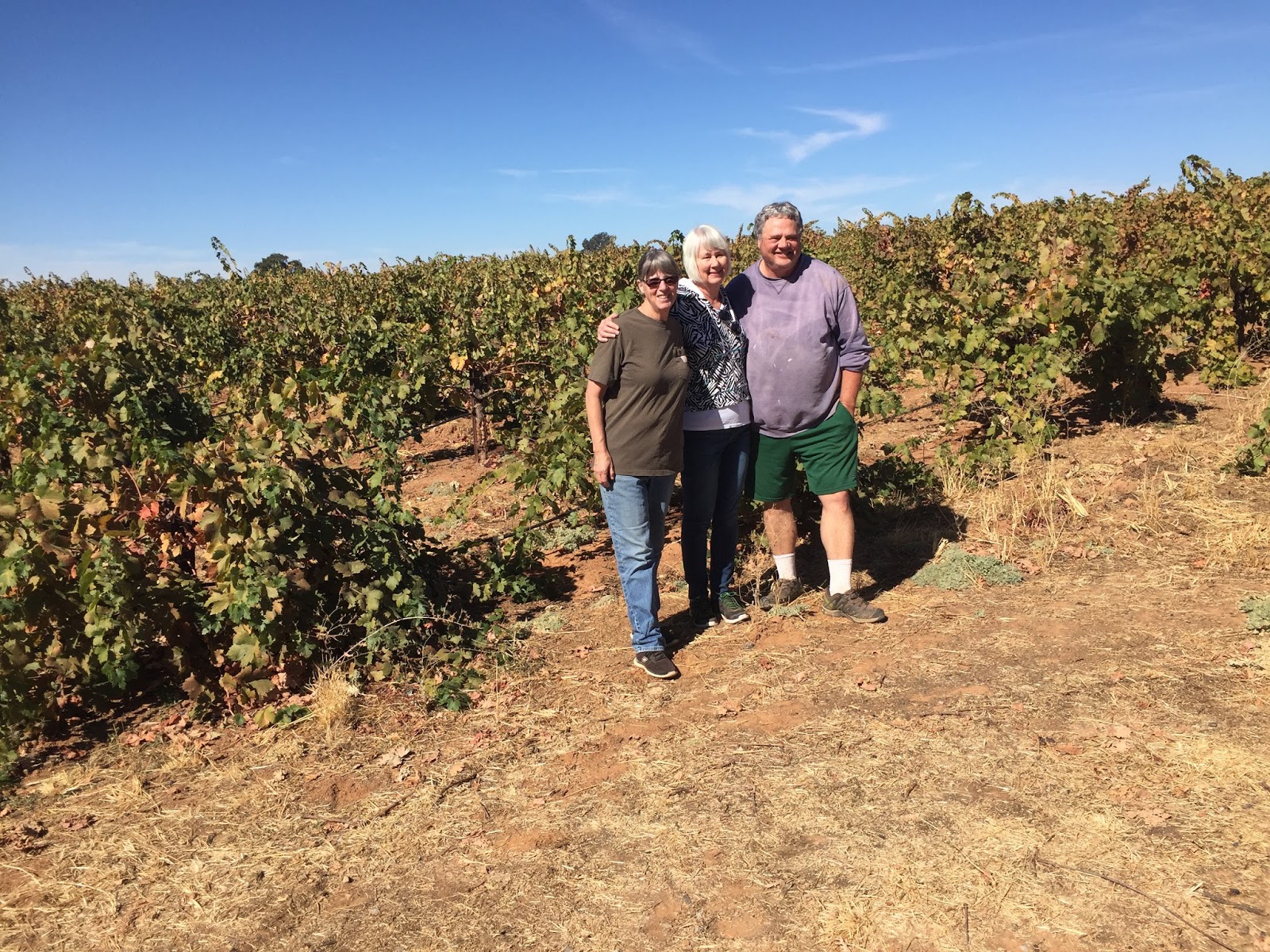
If you haven’t noticed, I’ve been on a food sourcing mission this past summer and plan to ramp it up in 2017. I read recently that 40% of the food that America grows each year is wasted. Shameful! I want to do my part to help reduce that number. The Baldinelli’s, friends I’ve made through the Master Food Preserver program, are grape growers in the Shenandoah Valley. Mike mentioned that following last year’s harvest they gleaned another 3,000 pounds of grapes, called seconds. I’m not sure if that has to do with the quality of the grape or because it’s the second time picking. I suspect the latter. He offered (I may have asked ;)) to have us over to pick as many grapes as we wanted. This is my kind of fun! Maria and Ruben were back from fishing and I invited them to spend the day with us. I know I’ve said this before, but there is something so special about picking your own food. It was a beautiful fall day. Mike and Joanne joined us in the vineyard and explained the differences to look for between the Zinfandel and Cabernet grapes. The Zin are larger and clusters not quite as tight as the Cabs. Mike gave us buckets and a special knife with a curved blade to cut the clusters from the vines. We picked for over an hour and according to my calculations went home with about a hundred pounds of grapes. 

Maria

Ruben

I’m writing this blog on the third day of juicing over 35 quarts of the stuff. I had no real plan for the juice except to make a batch or two of grape jelly. That was until I drank my first glass of Zin grape juice. It was so delicious I could only wonder why in the world people prefer the fermented version of it. I’m already planning to make grape picking (and juicing) an annual event and have more of our family join in the fun next year.

Before I sign off, I know you must be wondering how we extracted the juice. Readers moderately schooled in home food preservation techniques are thinking we cooked the grapes and then let them drip through a jelly bag. That is one approach that we’ve used for other fruit and it’s okay when making a small batch of jelly. But a hundred pounds? Not ok! We used a Steam Juicer. The fruit (and veggies of any kind) are placed in the steam basket on top and as the produce softens and cells break down the juice is released into a kettle that is equipped with a drain tube and clamp. After about an hour for grapes, longer for other produce, the clamp is removed and the juice flows into a container for storage. Easy Peasy! The juicing possibilities are endless.


Wednesday, September 14, 2016

Moser Fall Harvest

We’re seeing the first signs of fall here and I’m loving it. Morning temps have dropped to the mid-40’s. The deck is scattered with yellow leaves from the birch trees. Egg production has dwindled to a measly 6-8 eggs a day down from a consistent 18-20 eggs daily. If you don’t remember from my past ramblings, the hens always take a winter break, which seems to start earlier every year. Verne and I have been busy harvesting and preserving fall produce. Harvesting you ask? Yes, I’m finding more and more farms that have public u-pick programs that follow commercial harvesting. There is something so special about going to your food source, taking a close look at plants (I like to take pictures of them), squatting (that’s better than bending at the waist…very hard on your back), and picking your next meal.
Zucchini blossoms

Last week we spent one morning at Davis Ranch (Sloughhouse U-Pick) picking (in some cases just loading in our car) 184 pounds of food. This is no exaggeration. They have a weigh station and weigh your car as it enters the fields and then weigh it again when you leave. The corn, melons, winter squash and pumpkins have already been picked and are available on long wagons and tables. All other veggies, green beans, summer squash, cucumbers, eggplants, tomatoes and peppers are still on the plant in about a dozen different fields. This is where the squatting and picking come into play. We arrived early morning (not quite the “crack of dawn” when they open) and spent about 2 hours having fun in the fields. The incentive for me is the experience, not necessarily the 184 pounds of good eats. I literally have a new perspective on food, food sourcing, commercial growing, and especially Davis Ranch. Every time we drive to Sacramento, we pass Davis Ranch and its acres of crops from just-planted to full maturity. This is also true of our trips up and down the 5 freeway past miles and miles of fields and orchards being farmed. I always want to know what is growing and have a desire to take a closer look at the plants and their bounty. I can now say I’ve done just that at Davis Ranch. From our vantage point on the highway, we never realized the extent of the operation. They must have over a hundred acres of planted fields. It is immense and impressive. Well worth the $45 we spent for the experience. Oh, I haven’t mentioned the cost. They charge 25 cents a pound with a $25 minimum purchase.

Sloughhouse bins with pumpkins and winter squash


I know what you’re thinking. This is a fabulous deal, but only works for a food preserver. There is some truth to that statement. However, it doesn’t take a master food preserver to char peppers, wrap and freeze them. Or to blacken corn, cut it off the cob, bag it and freeze. Or blanch tomatoes, peel and freeze. (What it takes is a large freezer and a willing husband!) We did choose to can the tomatoes (20 quarts) because I’d just bought a pressure canner and I needed experience using it. But in years past I’ve roasted them (peels on) with a little balsamic vinegar and olive oil and frozen them in quart bags. They easily last over a year with no degradation in quality. We now have a year supply of some basic ingredients that we use weekly. No GMOs. No preservatives. No additives. Just pure goodness. I am more and more taking Michael Pollan’s mantra to heart…EAT FOOD, NOT TOO MUCH, MOSTLY PLANTS. I love that man!

Before - Sloughhouse peppers we picked

After - Charred peppers ready to be skinned and frozen

We took to the fields again yesterday. This time it was Apple Hill with our mission to enjoy one of High Hill Ranch’s famous apple fritters and, secondarily, buy apples to dehydrate…one of my favorite snacks. Limited for time, we didn’t actually pick directly from the fields this time, but instead from large bins of various types of early apples: Gravenstein, McIntosh, Delicious, Gala, Honey Crisp, Early Fuji, and others. Through mid-December, different varieties of apples and pears will be available at the 45 orchards, collectively called Apple Hill, that are open to the public. Visiting Apple Hill has become a family tradition that started as, and for years has simply been, a trip to High Hill (the first orchard on Carson Road that begins the loop through the Apple Hill country). We all had our favorites there from apple cider, caramel apples on a stick, caramel covered marshmallows (I have no idea what this has to do with apples), to apple fritters and apple donuts. A quick walkabout, including High Hill’s craft barn, and we were ready to drive back to Placerville for lunch and then head home. This was our routine for years until we learned there is so much more to Apple Hill than caramel apples and fritters. For one thing, Verne and I love canned pears and it is the perfect source of beautiful fresh Bartletts and other canning pears, as well as Asian pears (not your ordinary pear). Some of the farms grow various stone fruit and berries, are open year round, and offer u-pick opportunities. We have just begun to scratch the surface of this amazing collection of farms. We plan to visit Apple Hill at least two more times this fall, once in October to buy a case of our favorite apple, Pink Lady, and again in November just because. Each time we’ll visit more farms in search of a few new favorites to add to our list of food sources.

Verne buying our first apple fritter of the season

Bartlett pars at Boa Vista Orchards


Over the next few weeks we’ll be sourcing peppers for a salsa class I’ll be teaching in October and pressure canning tuna with son Scott in Portland. Good eats and good times…stay tuned.